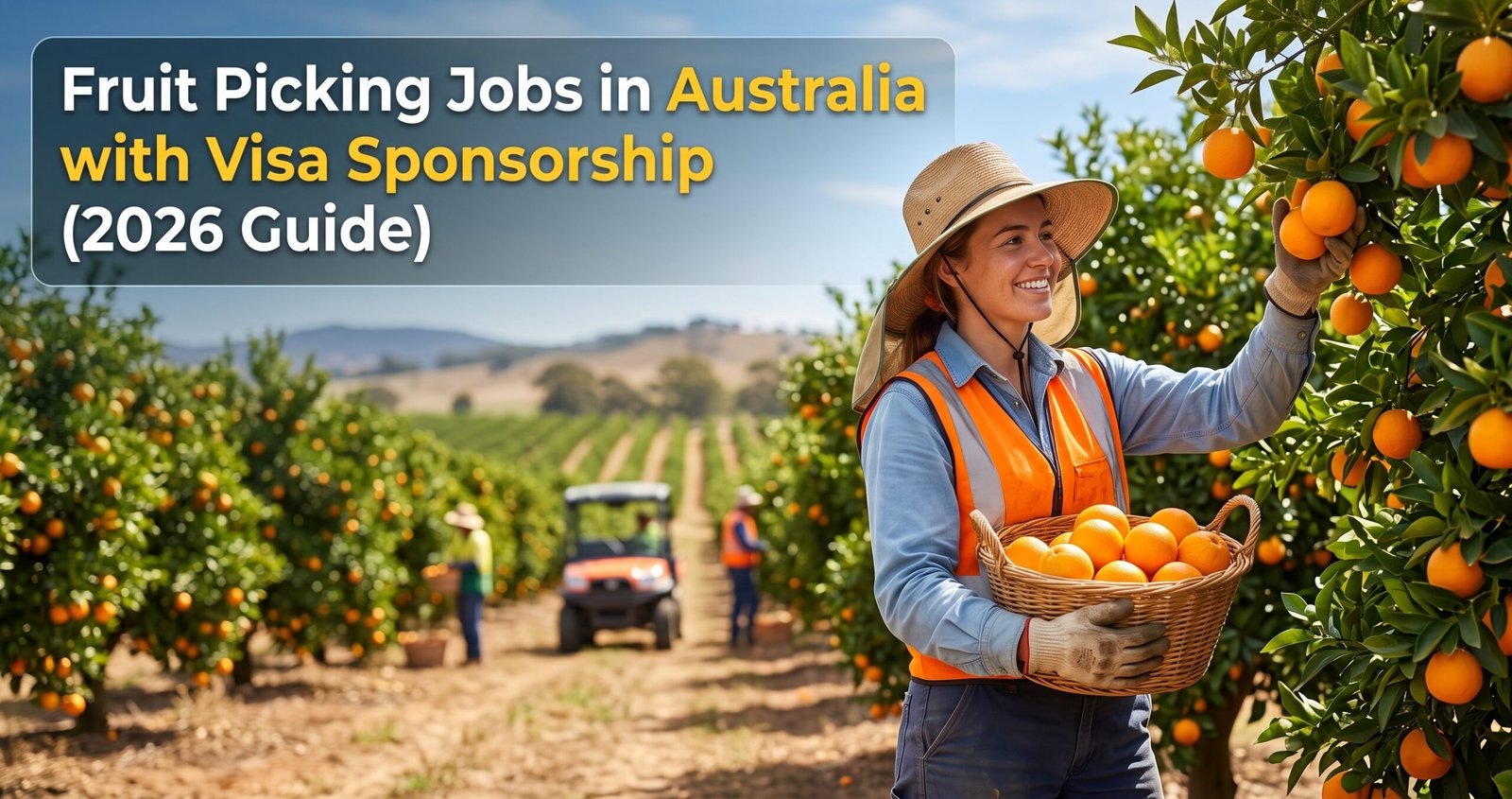
Fruit Picking Jobs in Australia with Visa Sponsorship (2026 Guide)
With conflicting visa requirements, changing immigration requirements and confusing boards of jobs, finding legitimate fruit jobs with visa sponsorship in Australia can seem a little overwhelming. Thousands of backpackers, seasonal workers and international job seekers move to regional and country Australia every year to work the massive farms of Australia. Before you pack your bags, however, you need to understand which visa types allow you to work in agriculture, what the legal pay rates are according to the Australian Fair Work Commission and the difference between a genuine agricultural sponsor and the not-so-legitimate sponsored position offered by recruiters who do not have the appropriate licence.
Overview: Agriculture and Seasonal Harvest Work in Australia
The horticulture industry is a key force in Australia’s economy, producing billions of dollars worth of fresh produce every year; this involves citrus, berries, stone fruits, apples, table grapes and vegetables. However, as crops start to grow, reach maturity, then dry and are cut at different stages across the different climatic zones that extend from the tropical northern parts of Queensland and the Northern Territory to the river valleys of temperate south Australia, help is needed in manual harvest work year round.
To harvest crops at their most productive stage, the Australian agriculture industry is greatly dependent on imported labour and crop migrant workers, in addition to working holidaymakers. The Australian Government has formal sponsorship and regional visa programs in place to help farms meet their workforce needs for both Australian citizens and authorities-approved migrants to balance demand, ensure legal visas and employment, and allow all workers to benefit from national employment laws.
Key Visa Options for Farm and Fruit Picking Jobs
The process of getting a job in agriculture in Australia will depend on the visa that one has that holds for them to have legal permission to work in their job. Job creation in agriculture is largely conditional to particular government-sponsored schemes as well as bilateral country agreements, in contrast to the common commercial office employment that is based mostly on private sponsor arrangements..
The Pacific Australia Labour Mobility
The PALM scheme is the main government initiative through which direct visa sponsorship for seasonal farming opportunities is offered directly to workers.
- Participating Nations: Citizens of Fiji, Kiribati, Nauru, Papua New Guinea, Samoa, Solomon Islands, Timor-Leste, Tonga, Tuvalu, and Vanuatu.
- Program Streams:
- Short-Term Seasonal Stream: For workers who are already employed for harvest, packing and horticulture for up to 9 months.
- Long-Term Stream: Emphasizes the transition to non-skilled, semi-skilled and agricultural field positions starting at 1 year and up to 4 years.
- How It Works: Workers are NOT applying to any random private farms online. Rather, they sign up with their own country’s official LSU (National Labour Sending Unit). The highly vetted and certified Australian Approved Employers will matching match with these national talent pools and recruit directly there after signing formal visa sponsorship, arranging flights and providing pastoral care of the employees.
Working Holiday Maker Visas
The Working Holiday Maker (WHM) program is the most popular route to harvest work, for travellers aged 18-30 (or 18-35 in selected partner countries including Canada, France, Ireland, the UK and Italy).
- Subclass 417 (Working Holiday Visa): Passports coy holders from European and Asian countries who have a partnership agreement can apply for subclass 417 working holiday visa.
- Subclass 462 (Work and Holiday Visa): Passport holders eligible through targeted ballot schemes in countries with bilateral work and holiday visa arrangements (such as the United States, Chile/Argentina, Indonesia, Vietnam and India).
- The 88-Day Extension Rule: If you do a horticulture or regional agriculture job for 88 days (3 months) in the first year you will then be eligible to apply for a Second Working Holiday Visa. After 6 months (179 days) of specified regional work in your second year, you can then apply for a Third Working Holiday Visa.
Designated Area Migration Agreements
The general (entry-level) fruit picking visa is normally only granted as a direct sponsor visa (such as subclass 482 Skill in Demand visa). But, agricultural heavy machinery operators, harvest managers, agriculture supervisors, and agricultural workers who have the extensive experience may be sponsored with:
- Designated Area Migration Agreements (DAMA): Regional agreements that provide exemptions for proficiency in English, salary requirements and occupational lists to meet ongoing shortages of labour to work in agriculture.
- Skilled Employer Sponsored Regional Visa (Subclass 494): Designed for semi-skilled and skilled employees working in farm management, who are recruited by a regional employer.
Step-by-Step Guide: How to Apply for Verified Harvest Positions
Agricultural recruitment is not something that can be done by simply walking in and is only appropriate if proper preparation is followed so as not to fall into a trap of a job that can’t be verified or is too exploitative.
Step 1: Establish Your Eligible Visa Channel
Find out what are your initial “requirements” before you contact companies.
- If you are from a Pacific island country or Timor-Leste, please register directly on your country’s Labour Sending Unit (LSU) to be added to the PALM scheme pool.
- If you have a Working Holiday visa agreement in your country, you can submit your visa application through the Australian Home Affairs (ImmiAccount) portal.
Step 2: Use Verified Job Boards and Harvest Placement Networks
Try not to use certain social media groups where scams are prevalent. Rather, employ official channels:
- Workforce Australia & Harvest Trail Services: Australian Government’s main employment engine which lists understanding seasonal openings in regional postcodes.
- MADEC Australia: A national non-profit provider under the Harvest Trail Services framework that provides job-matching services at no-cost for seasonal workers and certified growers, MADEC Australia.
- State-Specific Horticulture Associations: The National Horticulture Connotations, like Fruit Growers Victoria, Queensland Fruit & Vegetable Growers (QFVG) and Citrus Australia, often take certified harvest manuals listed.
Step 3: Verify Employer Credentials
Prior to accepting an offer:
- Ask the business for its name and take the time to check the title and Australian Government’s ABN (Australian Business Number) using the ABN Lookup service.
- Where States have mandatory labour hire licensing requirements (ACT, Queensland, Victoria and South Australia) check that the labour contractor has an active, unrevoked Labour Hire License.
Step 4: Setup Financial Infrastructure in Australia
When you’re about to begin your first shift, you should be sure to have:
- An Australian Tax File Number (TFN) issued by the Australian Assessment Office (ATO).
- An inactive Australian Bank Account in your legal tag.
- A recorded Superannuation Fund (or choice your employer’s avoidance obedient fund).
Step 5: Review the Employment Agreement
Ensure your convention clearly details:
- The applicable decoration (Horticulture Award 2020 / MA000028).
- Your classification level and occupation status (Unexpected, Full-Time, or Part-Time).
- The thorough base hourly proportion or guaranteed piecework structure.
- Clear declarations confirming no improper deductions for job employment or uniform fees.
Eligibility, Physical Requirements, and Document Checklist
Harvest works in a garden are physically challenging tasks that are outdoor-related and involve stamina, safety precautions and careful documentation.
Physical & Health Requirements
- Physical Stamina: Fruit picking includes extended hours on your bases, climbing ladders, carrying produce bags assessing 15–20 kg, and constant bending or attainment.
- Heat & Weather Resilience: Summer high temperature in district Australia can regularly outstrip 35°C (95°F). You must be capable of working carefully in hot, dry, or humid outdoor situations.
- Color Vision & Dexterity: Collecting requires individual between color inclines (e.g., differentiating prepared red fruit from undeveloped green variants) and suspicious handling to avoid fruit ,staining.
Working Conditions, Accommodation, and Logistics
Understanding what life expressions like on Australian farms helps avoid culture surprise and makes you for regional active.
Typical Daily Schedule
- Early Morning Starts: Shifts naturally commence at sunrise (between 5:30 AM and 6:30 AM) to capitalize on cooler morning hours and keep fruit value before the passion peaks.
- Shift Duration: Average shifts run 6 to 8 hours daily, often effective 5 to 6 days a week dependent on weather conditions, market logistics, and fruit growing rates.
- Weather Downtime: Heavy rain, exciting heatwaves, or surprising hail can provisionally suspend harvest processes. Planning your individual finances to billet weather-dependent downtime is important.
Regional Accommodation Models
- On-Farm Worker Cabins / Shearer Quarters: Budget-friendly lodging provided directly on possessions by recorded farms, generally extending from $120 to $180 AUD per week.
- Working Hostels: Creations located in agricultural hub settlements (e.g., Mildura, Shepparton, Bundaberg) that package dorm space with organized transport bus transport to local plantations.
- Independent Rentals & Procession Parks: Hiring a cabin, campervan site, or common house with associated seasonal workers.
How to Identify and Avoid Farm Work Scams
There is a high demand from outside Australia for Australian work visas, leading to many fraudulent agents and agents known as ‘middle-men’ promising jobs to job seekers.
Key Verification Rules:
- Never Pay for Job Placement: There are no placement or recruitment fees to pay under Australian law, whether for licensed employers, or for perfectly legal labour hire agencies.
- Always Insist on Itemized Payslips: legitimate employers should provide you with itemized payslips that show their ABN, working hours, pay, amount of tax deducted and superannuation paid. Cash in hand is illegal, it prevents you from having a workplace Injury Diagnosis on the job and it means that you will not be able to use your hours for extension of second/third year Working Holiday visas.
- Verify Registered Migration Agents (OMARA): If a person provides official visa processing services for a fee, check with the Australian Office of the Migration Agents Registry (OMARA) to find out if they are a registered migration agent.
Common Mistakes to Avoid When Applying
- Arriving Ahead of the Harvest Window: Being early enough at a farming town to arrive when fruits are still maturing, can cause you to empty your wallet. It is important to verify the dates for each area of harvest with the growers or with Harvest Trail itself before traveling.
- Ineligible Postcodes for WHM Extensions: If you are applying for your second or third year WHM visa, check that your farm or region’s postcode is listed as an eligible region (specified agriculture work) by the Department of Home Affairs.
- Failing to Keep Independent Daily Work Logs: Maintain a personal log or notebook of dates, start/end times, duration of breaks, number of kilograms/ bins harvested and supervisor names. This will safeguard you in case of pay difference or Visa checks.
- Neglecting Transportation Logistics: Not having any public transportation at all, with the orchards being out of cities 15–40 km. Decide if you should bring your own car, use carpooling or land a ride at the compound to go to the farm.
Also Read : uk-seasonal-farm-worker-jobs-2026/
FAQs
-
Can I get an Australian fruit picking visa with no prior farming experience?
Yes. Entry-level fruit gathering and packing roles (classified under Level 1 of the Cultivation Award) do not need formal agricultural experiences or prior farm experience. Employers rank physical fitness, regularity, reliable presence, and a robust work ethic.
-
How much money can an overseas fruit picker earn in Australia per week?
Created on the slightest casual mature rate of $32.18 per hour, a average 38-hour workweek yields a starting point gross income of almost $1,222.84 AUD before income tax. Decidedly productive pickers working below incentive piecework rates throughout peak season can receive significantly more, providing all piecework earnings chance or exceed the required hourly wage floor.
-
Can I bring my family on a seasonal fruit picking visa?
Under the short-term PALM seasonal stream (up to 9 months) and Occupied Holiday Maker visas (Subclass 417/462), additional dependents cannot be involved on your visa application. Long-term PALM contributors (1–4 years) and expert regional visa holders (Subclass 482/494) may be qualified to bring at the mercy of family members business to specific government criteria and employer arrangements.
-
What happens if I get injured while working on an Australian farm?
All workers in Australia—as well as seasonal, temporary, and international visa holders—are protected by state-level constitutional Workers’ Compensation insurance (e.g., WorkSafe in Victoria or SafeWork in NSW). If you stand an injury throughout your shifts, your employer is legally essential to report the incident, and you are allowed to medical dealing support and earnings compensation regardless of visa type.
Final Thought
Make safe a fruit picking job in Australia with visa sponsorship offers a legal, structured, and fiscally rewarding method to live and work in provincial Australia. By relying on official government stations like the PALM scheme and Personnel Australia Return Trail Services, thoughtful your minimum compensation rights under the Horticulture Award, and following the produce calendar across states, you can build a positive seasonal harvest journey while continuing safe and fully accommodating with Australian immigration laws.