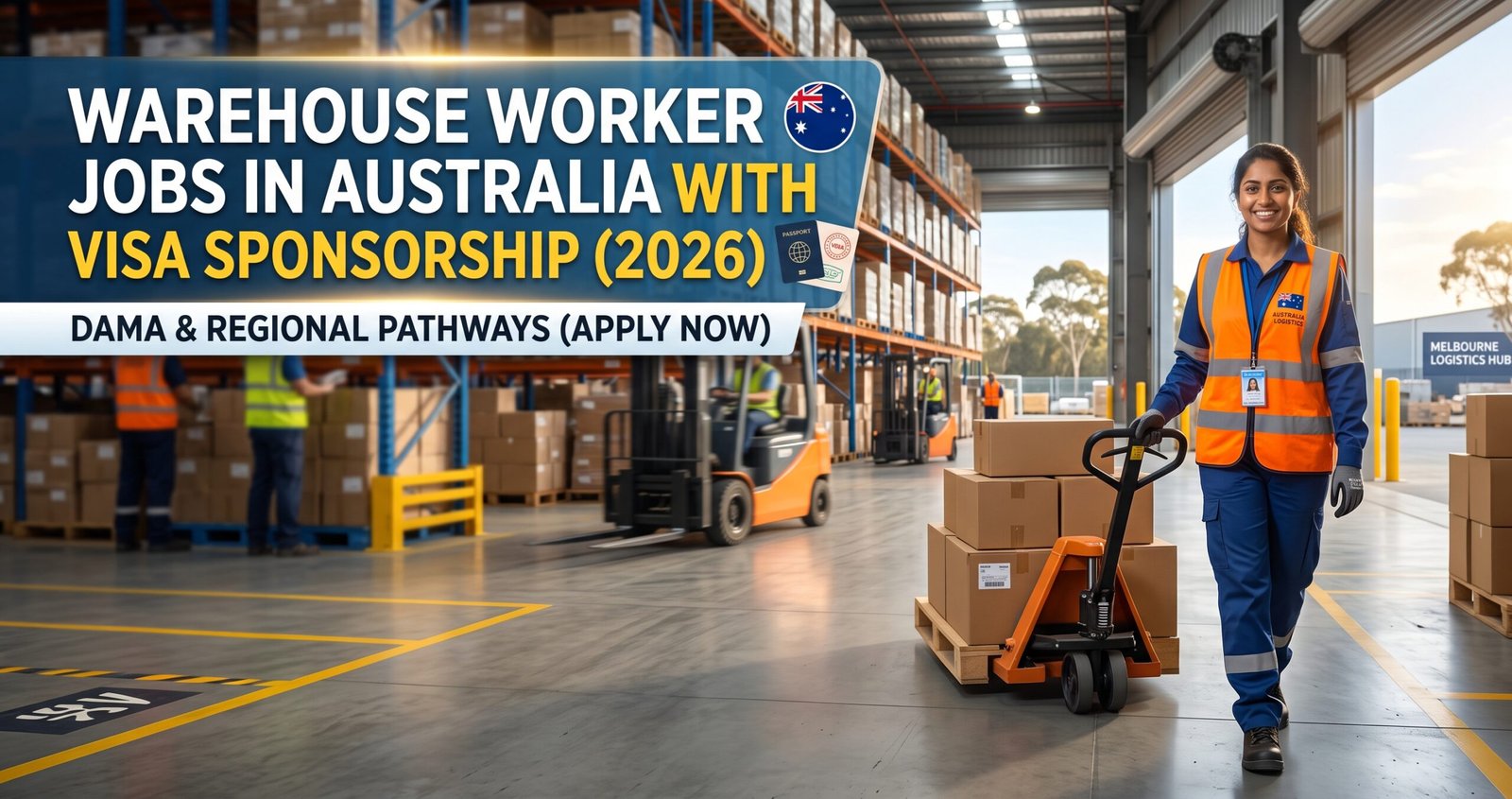
Warehouse Worker Jobs In Australia with Visa Sponsorship (2026)
Logistics, supply chain and e-commerce are booming in Australia. The distance between major cities and enormous need to have highly efficient freight transport networks, are contributing to the high demand for fully skilled warehouse personnel and semi-skilled workers. For those seeking to move to Australia from overseas, though, the steps you take to secure a position aren’t as straightforward as simply applying for a job online. Getting warehouse worker visa sponsorship jobs in Australian involves a thorough grasp of the recent immigration changes in Australia.
As a storeperson, forklift, logistics coordinator or dept manager for the supply chain, you may be thinking about how you’ll handle the tricky visa system. It has certainly been a positive change in the Australian migration rules with the new visa category called Skilled in Demand (SID) visa and the expansion of Designated Area Migration Agreements (DAMA), which have legitimate legal visa options available for those who wish to live and work in Australia.
Overview: The Australian Warehousing and Logistics Boom
Australia is an enormous country that’s extremely sparsely populated. The country depends heavily the robust supply chain network in order to guarantee the delivery of hospital provisions, packages for ecommerce and keeping the supermarket shelves supplied with products in time. This digital transformation over the past few years is causing a massive surge in warehouse development throughout Sydney, Melbourne, Brisbane, Perth and other key regional hubs.
The expansion in the sector is not stopping Australian employers from often failing to recruit local workers to address key industry skills shortages. Warehouses operate around the clock, and this demands staff to work around the clock, operate complex inventory software, and operate heavy machinery. This serious labor deficit has compelled the government and private industry to find those willing to cross the border to recruit new labour.
Understanding Visa Sponsorship for Warehouse Workers in 2026
There have been huge alterations in visa sponsorship in Australia in recent times. Old TSS (482) visa process has been replaced with Skills in Demand (SID) visa process. The new system aims to be more responsive to the country’s economic requirements, providing increased flexibility of work and more secure options for citizenship for residents.
One of the most important issues for warehouse staff to grasp is how you will operate in this new system. There are three streams to the Skills in Demand visa:
The Specialist Skills Pathway
This pathway is intended for highly paid, specialised professionals (annual income of more than $146,576 AUD). For typical warehouse jobs this pathway will not apply unless you are a high-level supply chain executive or advanced logistics systems architect.
The Core Skills Pathway
As one of the most common streams in connection with other migrations in Australia, this stream allows obtaining a visa according to skills. It depends on the Core Skills Occupation List (CSOL) and has a minimum wage per year (as of mid-2026, this is $79,423 AUD). This typically includes positions at a higher level, like Supply and Distribution Managers, or Procurement Managers. But in general, workers involved in warehouse operations, such as pickers and packers, are not eligible to be part of the CSOL.
The Essential Skills Pathway (Labour Agreements)
That’s where most general warehouse employees, forklift drivers and machine operators get the opportunity. This pathway is for essential workers who are earning below the Core Skills threshold. It is largely based on certain Labour Agreements negotiated between the Government and certain industries / regions. These are primarily the Designated Area Migration Agreements (DAMAs).
Typical Warehouse Roles Sponsored in Australia
The position title is incredibly important when looking for visa assistance. The eligibility for Australian immigration is based on the code(s) associated with specific occupation(s) that are standardised across Australia and New Zealand (ANZSCO). Here’s what the proper jobs could be:
Supply and Distribution Manager (ANZSCO 133611)
This is an extremely technical job that deals with organizing and managing goods supply, storage and distribution. This position is normally able to be reimbursed at standard Core Skills rate. A related degree and several years of management experience will be required.
Storeperson / Picker-Packer
It is actually the foundation in any warehouse. This requires tasks such as reception, collect using Radio Frequency scanner, packing and inventory keeping. These classes of visas are not skill-based visas, but are often sponsored on a DAMA basis where there is a shortage of skilled workers in Australia.
Forklift Driver / Machinery Operator
Heavy duty lifting equipment work is a particular job skill. Driving a forklift in Australia requires a certain High Risk Work Licence. Professional machine operator trainees are also sought after by regional employers, mainly in mining, construction and agricultural warehousing, from DAMAs.
Logistics Clerk / Inventory Controller
These positions are in between the warehouse and the management. These include inputting data, overseeing delivery progress, handling returned products, and arranging with delivery drivers. These can sometimes be accommodated within the normal administrative visa or the regional agreement depending on the specific work tasks.
Eligibility, Licences, and Legal Requirements
Experience alone is not enough to be a successful sponsor. There are strict conditions imposed by the Australian Department of Home Affairs, and by State based workplace safety regulators..
Skills Assessment and Experience
To qualify for most sponsored visas, you will need to fulfil the requirement of holding 1-3 years’ of relevant full-time work experience. Formal Skills Assessment (e.g. from a recognised Australian body – VETASSESS) may be required for certain higher level positions. DAMA positions will be evaluated with regards to job description and experience in the region.
High Risk Work Licence (Forklift)
Anyone who works with a forklift (standard level forklift or order picking forklift) needs to be issued an Australian High Risk Work Licence. Important thing to remember is that overseas forklift licences are not recognised in Australia. Direct translation of licenses from home country not possible.
Upon arrival in Australia your employer will usually want you to take a 2-3 day training course and sit a practical test with a Registered Training Organisation (RTO) to obtain your Australian ticket.
English Language Proficiency
Normally the proof of English proficiency is in the form of a test such as IELTS or PTE (typically with a minimum score of 5.0 or 6.0 is sufficient for the visa). One of the great advantages though, of the DAMA program, is that numerous versions include concessions in the English language that reduce the English language proficiency for semi-skilled workers within that specific warehouse.
Health and Character Checks
All Australian employed visas want you to pass a medical inspection to confirm you do not pose a significant problem on the healthcare system. As well, you must offer police permission certificates from any country you have existed in for more than 12 months in the older 10 years.
Salary Expectations and Working Conditions
Australia’s working hours are largely regulated and have one of the highest minimum wages in the world. Your employment contract with your employer is a contract of service and, as such, you have the same rights as an Australian citizen. There is no discrimination against a visa worker’s ability to be paid less.
The Salary Threshold vs. Modern Awards
The government requires at least a minimum salary for Core Skills visas (currently $79,423 AUD). On the other hand, a sponsored minimum under a DAMA may be somewhat decreased for the exact area and to mirror the semi-skilled nature of job.
Irrespective of the visa threshold, your pay essential also aligns with the Packing Services and Wholesale Award (the allowed document exactness minimum pay charges in Australia).
- Base Hourly Rates: An entry-level warehouse employee typically produces between $24.00 and $30.00 AUD per hour. Skilled forklift drivers and shift managers earn expressively more.
- Penalty Rates: If you work nightfall, nights, weekends, or public outings, Australian law dictates that you obligation be paid “consequence rates.” Working on a Sunday, for example, can effect in being professional 150% to 200% of your normal hourly rate.
- Superannuation: On top of your income, your employer obligation officially pay a proportion of your earnings (presently 11.5% as of 2026) into a retreat fund well-known as Superannuation.
Step-by-Step Guide to Finding Sponsored Jobs
Finding an employer prepared to sponsor you is a inexpensive process. You are challenging not only with local Australians but with claimants from all over the world. Here is a representative, structured method to finding sponsorship.
Step 1: Tailor Your Resume for the Australian Market
Australian employers prefer fresh, concise restarts (usually 2-3 pages). Do not contain personal details like your marital status, faith, or a photograph. Concentration comprehensively on:
- Relevant Experience: Highpoint exact technology you can work (e.g., Reach trucks, counterbalance forklifts, RF scanners).
- Safety Record: Stress your considerate of Work-related Health and Protection (OHS) protocols.
- Visa Status: Be honest. State obviously: “Currently exist in in [Your Country], looking for Subclass 482/DAMA Employer Sponsorship.”
Step 2: Mark DAMA Regions
Don’t blip in town to apply for any jobs in Sydney’s CBD. Rather, conduct research for the active DAMA regions (such as Orana, WA or regional South Australia). Check for big agricultural logistics companies, distribution centres with a regional focus or mining-related companies with a presence in these post codes.
Step 3: Use the Right Job Boards
Although SEEK, Indeed, and Jora are the leading job boards in Australia, you essential to use specific exploration terms.
- In its place of just searching “Warehouse Worker,” quest for standings like:
- “Visa sponsorship available”
- “482 sponsorship”
- “DAMA sponsorship warehouse”
- “Regional employer sponsorship”
Step 4: Network and Use Recruitment Agencies
For a lot of big logistics businesses, there is a specific method of hiring and opting for a specialized recruitment agency like Workforce, Programmed or Hays. Contact regional placement and international migration looking for recruiters.
Step 5: The Interview and Nomination
An employer must first apply to become an approved employer to sponsor you to work, and then nominate the position they would like the government to offer you. Once nominated you can apply for your visa. Have all your documents (passports, skills assessment, English tests) handy before they are required – this could result in an employer withdrawing the offer if you delay bringing forward the required documents.
Critical Red Flags and Scams to Avoid
Unfortunately, scammers prey upon the immigration sector since the desire to move to Australia is strong enough. As an employer, you need to keep yourself secure. The laws on visa sponsorship are enforced strictly by the Australian Government..
Paying for a Job Offer
In Australia it is the absolute law that you cannot be required to pay a visa sponsor or employer to secure a job offer or visa sponsorship. This is referred to as “visa sponsorship for pay” and you will incur serious penalties, ranging from visa restrictions to entering Australia and the employer will receive severe penalties. Visa application costs are your responsibility, but never paid to an employer to work for them.
“100% Guaranteed Visa Approval”
Apply for visas—and no one can guarantee that you’ll get them except the Australian Department of Home Affairs. If an agency guarantees 100 percent success, then that’s a sign that they are lying.
Unregistered Migration Agents
If you select to use an manager to help with your filing, they must be registered with the Office of the Relocation Agents Registration Expert (MARA). Always ask for their MARN (Migration Agent Process Number) and confirm it on the official MARA website.
Fake Job Listings
Scammers often generate fake websites impersonating real logistics companies. They will comportment a quick online meeting and then demand thousands of dollars for “dispensation fees” before you even reach. Always citation the company’s specifics, call their official Australian phone number, and confirm their presence on the Australian Corporate Register (ABR).
Also Read : germany-visa-sponsorship-jobs-2026/
FAQs
-
Can I bring my family with me on a warehouse worker visa?
Yes. If you are decided a Skills in Demand (Subclass 482) visa or a local Subclass 494 visa, you can contain your partner (or de facto partner) and reliant on children in your request. They will have full work and learning rights in Australia.
-
Do I need a degree to work in an Australian warehouse?
For general level roles (picker/packer, forklift driver) supported under a DAMA, a gradation is not required. Experience and protection certifications are ample more important. However, for higher-level source chain organization roles under normal visas, a Bachelor’s gradation or higher is usually mandatory.
-
Can a warehouse job lead to Permanent Residency (PR)?
Yes, this is one of the prime changes in current years. The different Skills in Demand visa framework offers clearer pathways to eternal residency for all torrents. Similarly, greatest DAMAs offer a evolution to PR (usually done the Subclass 186 or 191 visas) next you have lived and worked in the local area for a set number of ages (typically 3 years).
-
How long does the visa processing take?
Dispensation times vary built on the exact visa stream and how well-prepared your application is. Generally, employer nomination and visa dispensation can take anyplace from 2 to 8 months. Applying finished a DAMA includes an extra step (the employer obligation get local endorsement first), which can add some weeks to the timeline.
Final Thought
It is possible to find a job as a warehouse worker in Australia in 2026, but it might require some effort and a bit of luck to land THE one. That’s the Australian logistics sector is booming and there’s a shortfall of talented and skilled local staff which has made it the government’s need to generate viable, lawful pathways for international talent.
The standard Skills in Demand Core Pathway is for those who are high skilled and are managing their supply chain. If you are a semi-skilled worker (e.g. forklift operator; storeperson); your core emphasis can be on Designated Area Migration Agreements (DAMAs). You can do this by focusing on the regional employers in places where they’re looking for logistics workers, you’ll tailor your resume to the Australian format, and you’ll avoid illegal “pay-for-visa” schemes.